What Is a Frenum? Oral Frenula Explained
⚡ Key Clinical Takeaways
- A frenum (also called a frenulum) is a small fold of tissue that connects one part of the mouth to another and limits how far that part can move.
- A frenum is a fold of mucous membrane that contains connective tissue and muscle fibers.
- Dentists and clinicians generally describe several frena inside the mouth:
- Frena serve a mechanical purpose.
- Not every prominent frenum requires treatment.
Quick answer
A frenum (also called a frenulum) is a small fold of tissue that connects one part of the mouth to another and limits how far that part can move. In the mouth, frena attach the lips and cheeks to the gums and the tongue to the floor of the mouth. Most people have several oral frena without any symptoms, but when one is unusually short or tight, it may affect feeding, speech, or oral hygiene and could be evaluated for treatment.
At a glance
- A frenum is a thin band of connective tissue covered by mucous membrane.
- Common oral frena include the lingual, labial, and buccal frena.
- Frena help stabilize the lips, cheeks, and tongue during eating and speaking.
- A tight or short frenum may contribute to tongue-tie or lip-tie.
- Evaluation is typically performed by a dentist, pediatrician, or ENT specialist.
- Care may range from observation to a minor surgical release.
What Is a Frenum?
A frenum is a fold of mucous membrane that contains connective tissue and muscle fibers. It acts as an anchor, restricting excessive movement of the lip, cheek, or tongue. The terms frenum and frenulum are often used interchangeably, though some clinicians use frenulum to describe a smaller fold. You can read more about the distinction in our guide on frenum vs frenulum.
Oral frena are normal structures. Everyone has them, and they form during fetal development. Their presence alone is not a disorder. Problems arise only when a frenum’s length, thickness, or attachment point interferes with normal function.
Types of Frena in the Mouth
Dentists and clinicians generally describe several frena inside the mouth:
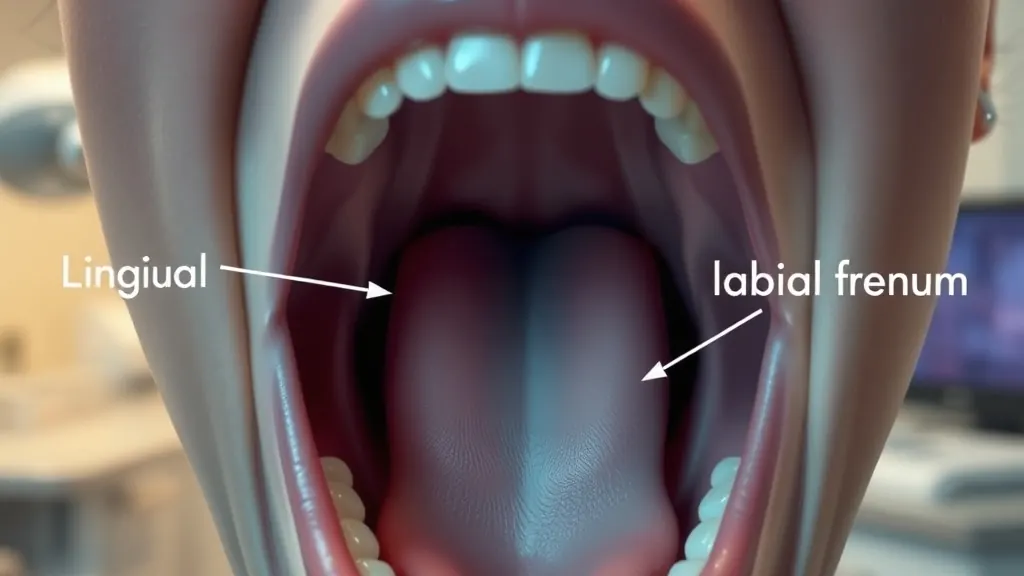
Lingual frenum
The lingual frenum connects the underside of the tongue to the floor of the mouth. It is the tissue most often discussed in cases of tongue-tie. More detail is available in our overview of the frenulum in tongue.
Maxillary labial frenum
This frenum runs from the inside of the upper lip to the gum tissue above the upper front teeth. A prominent or low-attaching maxillary labial frenum is sometimes associated with a gap between the front teeth.
Mandibular labial frenum
This frenum connects the inside of the lower lip to the gum below the lower front teeth. It is usually less noticeable than the upper labial frenum.
Buccal frena
Buccal frena are bands of tissue that connect the cheeks to the gums near the molars. There are typically several on each side of the mouth.
| Frenum | Location | General role |
|---|---|---|
| Lingual frenum | Underside of the tongue to the floor of the mouth | Helps anchor and guide tongue movement |
| Maxillary labial frenum | Upper lip to the gum above the front teeth | Stabilizes the upper lip |
| Mandibular labial frenum | Lower lip to the gum below the front teeth | Stabilizes the lower lip |
| Buccal frenum | Cheek to the gum near the molars | Connects cheek tissue to the alveolar ridge |
What Does a Frenum Do?
Frena serve a mechanical purpose. By tethering mobile structures to fixed bone or gum tissue, they help coordinate the movements needed for sucking, swallowing, chewing, and speech. For example, the lingual frenum prevents the tongue from moving too far backward, while the labial frena keep the lips from pulling too far away from the teeth.
During infancy, normal frenum length and mobility support breastfeeding or bottle feeding. As children grow, frena continue to contribute to speech articulation and oral hygiene by limiting excessive lip or tongue traction on the gums.
When a Frenum May Cause Problems
Not every prominent frenum requires treatment. However, a frenum that is short, thick, or attached close to the edge of the gum or tongue tip can restrict movement. This restriction is commonly described as tongue-tie when it involves the lingual frenum, or lip-tie when it involves a labial frenum.
Potential signs include:
- Difficulty latching during breastfeeding in infants
- Speech sound errors in older children
- Difficulty cleaning the gumline or teeth
- A noticeable gap between the upper front teeth
- Gum tissue pulling away from the teeth in some cases
Because symptoms overlap with many other conditions, a clinician should assess whether the frenum is truly the cause before recommending a procedure.
How Frenum Issues Are Evaluated
Evaluation usually involves a physical exam and a functional review. A pediatric dentist, pediatrician, or ear, nose, and throat (ENT) specialist may look at where the frenum attaches and how far the tongue or lip can move. A speech-language pathologist may also assess speech or feeding concerns.
Professional organizations such as the American Academy of Pediatric Dentistry (AAPD) and the American Academy of Otolaryngology–Head and Neck Surgery (AAO-HNS) recognize that diagnosis should consider both anatomy and function, not appearance alone. There is no single measurement that applies to every patient.
Treatment Options for Problematic Frena
When a frenum causes functional problems, treatment options may include observation, a frenotomy, or a frenectomy. A frenotomy is a small release of the tissue, while a frenectomy involves removing or reshaping part of the frenum. You can learn more about the difference in our comparison of frenotomy versus frenectomy.
Procedures may be performed with a scalpel, scissors, or a dental laser. Information about laser approaches is available in our guide to laser frenectomy. The choice of technique depends on the patient’s age, the type of frenum, and the clinician’s judgment.
| Approach | What it involves | Typical setting |
|---|---|---|
| Frenotomy | A small incision or snip to release the tissue | Often performed during an office visit, especially for infants |
| Frenectomy | Removal or reshaping of part of the frenum | May be performed in a dental or surgical office |
Some patients benefit from a full frenectomy, while others need only a minor release. Decisions are made case by case.
Recovery and Aftercare Basics
After a frenum procedure, healing generally occurs over days to weeks. Providers may recommend gentle stretching or wound-care instructions to reduce the chance of reattachment. Follow-up visits allow the clinician to check healing and confirm that movement has improved.
More details about what to expect after the procedure are available in our article on recovery after a frenectomy.
Frequently Asked Questions
Is a frenum the same as a frenulum?
The terms are often used interchangeably in everyday conversation. Clinically, frenulum may refer to a smaller fold, but both describe the same type of tissue band in the mouth.
How many frena are in the mouth?
Most people have several, including one lingual frenum, two labial frena, and multiple buccal frena on each cheek. Exact numbers can vary slightly from person to person.
Does every tight frenum need treatment?
No. Treatment is considered only when the frenum causes functional problems with feeding, speech, or oral hygiene. Many people have tight frena without symptoms.
Can adults have frenum issues?
Yes. Although tongue-tie and lip-tie are often identified in infants, adults can also experience restrictions that affect speech, eating, or periodontal health.
Is a frenectomy the only treatment for a tight frenum?
No. Options include observation, frenotomy, or frenectomy depending on the severity and symptoms. A clinician can help determine which approach fits the situation.
How long does healing take after a frenum procedure?
Healing time varies by patient and procedure type. Initial healing often happens within a week or two, with full tissue maturation taking longer.
References
- American Academy of Pediatric Dentistry (AAPD)
- American Academy of Otolaryngology–Head and Neck Surgery (AAO-HNS)
- American Dental Association (ADA)
- Mayo Clinic
- MedlinePlus, U.S. National Library of Medicine
Medical disclaimer
This article provides general information about oral anatomy and frenum-related conditions. It is not medical advice and does not replace evaluation or treatment by a licensed healthcare provider. If you or your child has symptoms related to a tongue-tie, lip-tie, or other oral frenum concern, consult a qualified dentist, pediatrician, or ENT specialist.
Reviewed by the frenectomyguide.com editorial team · Last updated 2026-10-30
Ready to find an accredited frenectomy provider near you?
Browse 15,302 verified frenectomy centers (0 verified), filter by tests and treatments, and reach out directly — all in one verified directory.
🔍 Search Accredited Centersor call a clinic directly from its profile — every listing has a verified phone number.
This medical guide complies with the American Academy of Oral Surgery (AAPD) standards of care for oral restrictions and reflects generally accepted clinical guidelines. It is informational and not a substitute for personalized medical advice.